This air hose buying guide explores essential pneumatic hose materials (Poly, Rubber,Hybrid, PVC), diameters, and...
A Comprehensive Industrial Sandblasting Hose Selection Guide
Introduction: The Strategic Value of the Blasting Hose System in Advanced Surface Engineering
In modern surface treatment and protective coating applications, the efficacy and cost-efficiency of abrasive blasting are directly determined by the integrity of the conveyance system. The sandblasting hose is arguably the most crucial, yet often underestimated, component. Extensive industry analysis reveals that suboptimal sandblast hose selection and management can account for a staggering 30–50% loss of kinetic energy in the compressed air supply. This energy deficit translates directly into slower production rates, increased consumption of compressed air, and significantly higher operational expenditure. Moreover, the failure of a structurally compromised sandblaster hose operating under high pressure presents an acute safety hazard, risking catastrophic equipment damage and severe personnel injury.
This extended technical guide adopts a rigorous systems engineering perspective. It provides surface treatment professionals with a deep-dive technical framework for selecting, deploying, and maintaining optimal sandblasting hose systems. We will meticulously examine the advanced material science, fluid dynamic principles, and best practice maintenance strategies required to transform the sandblast hose from a simple consumable into a strategically managed asset, thereby enhancing process control and profitability.
Part I: Engineering Fundamentals of Blasting Hoses: An Advanced Structural Analysis
1.1 Structural and Material Analysis of a Sandblaster Hose
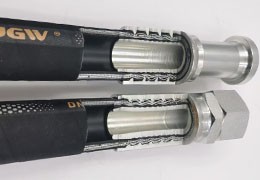
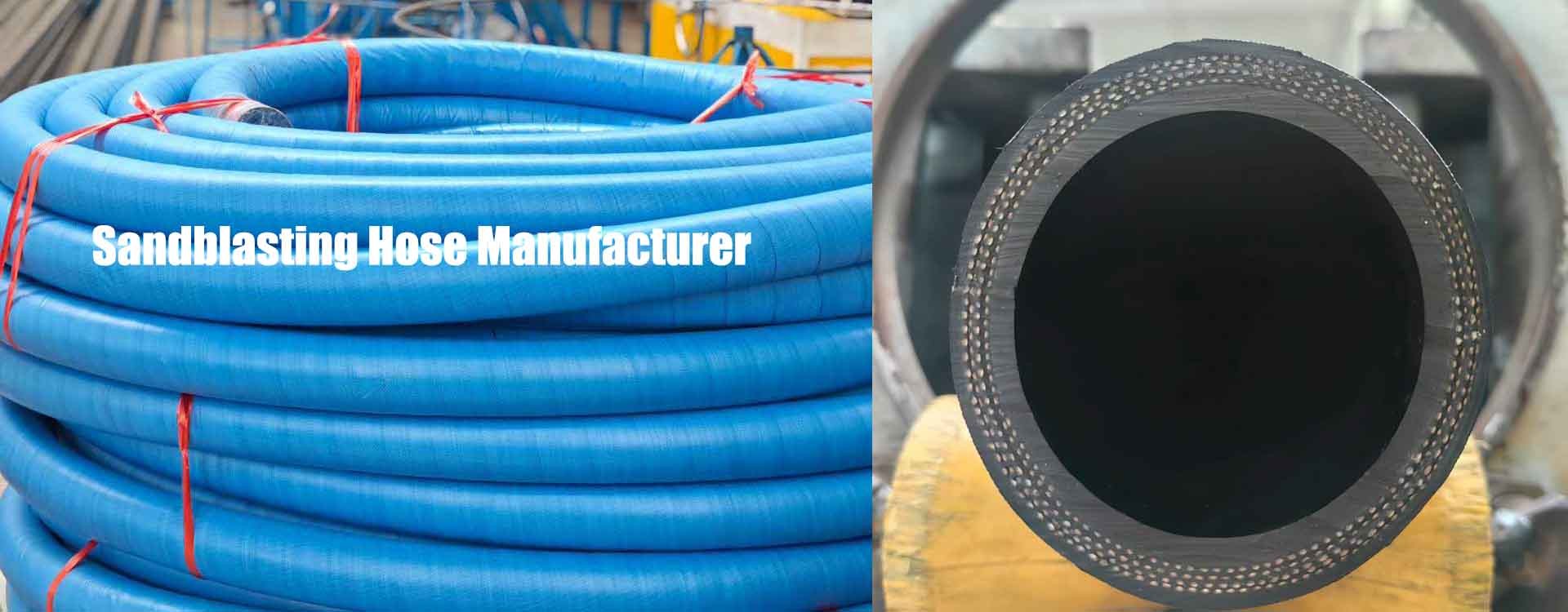
A professional-grade sandblasting hose is a precision-engineered composite structure designed to withstand the tri-modal stresses of high internal pressure, severe internal abrasion, and aggressive external environmental factors.
The Inner Tube (Abrasive Contact Layer): The Abrasion Apex
This layer is the primary point of kinetic energy transfer and physical wear. Its performance is paramount to the sandblaster hose longevity and efficiency.
• Material Composition & Hardness: The inner tube primarily utilizes materials with exceptional wear characteristics, such such as Ultra-High Molecular Weight Polyethylene (UHMWPE), specialized Natural Rubber (NR) compounds, or highly reinforced synthetic rubbers. High-quality compounds typically exhibit a Shore A hardness of 60 to 80. The specific choice of polymer—whether it is the low-friction and high-impact resistance of UHMWPE or the superior resilience and cut-and-gouge resistance of specially formulated natural rubber—depends heavily on the abrasive medium and working temperature.
• Surface Finish and Flow Dynamics: The internal surface must be exceptionally smooth to minimize the coefficient of friction (). A rough inner wall dramatically increases the drag coefficient, leading to premature deceleration of the abrasive particles and subsequent energy loss. A smoother surface promotes laminar flow conditions (relative to the gas phase), maintaining the high velocity required for effective blasting.
The Reinforcement Layer (Pressure Skeleton): Stress Management
The reinforcement layer provides the structural integrity necessary for the sandblasting hose to contain high-pressure air and maintain its dimensional stability.
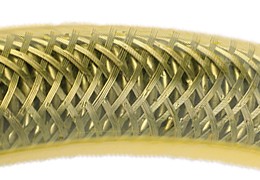
• Braiding Architecture: Industrial sandblast hose often employs multi-ply synthetic fiber braiding (e.g., polyester, aramid). These plies are typically woven with opposing angles (e.g., is the "neutral" angle for maximum pressure resistance) to counteract the stress tensor generated by internal pressure, preventing excessive expansion or length change.
• Steel Reinforcement: For high-pressure or large-diameter applications, helical or spiral steel wire reinforcement is integrated. This steel skeleton significantly elevates the burst pressure and prevents kinking or collapse under vacuum, but it necessitates specialized, robust sandblast hose fittings.
• Safety Factor Rationale: A standard safety factor of 4:1 (Burst Pressure: Working Pressure) is mandatory. This factor accounts for material fatigue, minor manufacturing variations, pressure spikes during operation, and the inevitable reduction in material integrity over the sandblaster hose lifespan.
The Outer Cover (Protective Layer): Environmental Shielding
The outer cover safeguards the structural layers from external degradation. It is generally formulated from weather-resistant synthetic rubber (e.g., EPDM, CR) to protect against:
• Ozone Cracking: Especially critical in coastal or polluted industrial environments.
• UV Degradation: Prevents the loss of mechanical properties due to sun exposure.
• Chemical Splash: Resistance to common industrial solvents, paints, and oils.
1.2 Sandblaster Hose Key Performance Indicators and Technical Specifications

1.3 Sandblast Hose Material Science Perspective: The Chemistry of Resilience
Rubber Matrix Selection and Compound Engineering
The selection is not simply a single material but a complex compound of polymers, fillers, curatives, and anti-degradants.
Natural Rubber (NR): Offers the highest resilience, elasticity, and tear strength. It is excellent for absorbing the impact energy of large, angular abrasives. However, its poor resistance to oil and ozone necessitates protective additives.
Styrene-Butadiene Rubber (SBR): Often blended with NR to improve abrasion resistance and reduce cost. It is a workhorse material for general-purpose sandblasting hose.
Polyurethane (PU) and UHMWPE: These thermoplastics offer superior smooth-bore characteristics and extremely low friction, making them ideal for high-velocity, fine-particle applications where maintaining kinetic energy is critical.
Advanced Reinforcement and Composite Innovations
The drive for longer life in the sandblast hose has led to innovations:
Nanocomposite Fillers: Incorporating nanoparticles (e.g., specialized carbon blacks, nanoclays, or functionalized graphene) into the rubber matrix significantly increases the material's elastic modulus and ultimate tensile strength, thus improving overall cut and abrasion resistance.
Ceramic Enhancement: For handling the hardest abrasives (like Silicon Carbide), some premium inner linings are embedded with micro- or nano-sized ceramic particles.This elevates the wear-resistance rating by 200−300% compared to standard rubber.
Part II: Sandblasting Hose Sizing Selection Methodology: Applied Fluid Dynamics
2.1 Applied Fluid Dynamic Principles: The Power Law of Diameter
The efficiency of a sandblasting hose system is fundamentally dictated by the principles of gas-solid two-phase flow—the interaction between compressed air and abrasive particles. The critical technical insight here is the Power Law of Diameter, which governs how much energy is lost as the mixture travels through the hose.
Simply put, the pressure loss that occurs inside the hose is related to the diameter not in a linear fashion, but exponentially. Specifically, if you halve the inner diameter, the resulting pressure drop—the force wasted overcoming friction—will increase by about 32 times (the fifth power of two). Conversely, even a minor increase in the hose’s internal diameter, such as moving from a 1 inch to a 1.5 inch sandblast hose, can slash the internal resistance and reduce the pressure loss by over 80% under identical flow conditions. This remarkable energy preservation is why the strategic sizing of the sandblasting hose is the single most critical factor in system optimization and a primary determinant of your blasting speed and abrasive velocity. You're not just moving air; you're preserving the kinetic energy that does the actual work.
2.2 Blasting Hose Diameter Selection Decision Model: Matching System Components
Scientific hose selection must always begin at the point of action: the sandblasting hose and nozzle. The nozzle’s bore size is the system's throttle, setting the precise volume of air required (the CFM rate) and dictating the necessary exit velocity. Every component upstream must be sized to feed this terminal point without choking the flow.
The Nozzle-Hose Ratio: Preventing the Choke Point
The initial step involves establishing the correct ratio between the nozzle orifice and the hose diameters.
Air Supply Hose (Compressor to Pot): The inner diameter (ID) of the air supply sandblasting hose should be a minimum of four times the nozzle orifice ID. This "4x Rule" is designed to eliminate flow restrictions between the compressor and the mixing vessel (the pot), ensuring the mixing unit receives a full, uninterrupted volume of compressed air.
Abrasive Delivery Hose (Pot to Nozzle): For the abrasive delivery sandblast hose, which carries the heavier, two-phase mix, the required ID ratio is typically slightly lower, ranging from 2.5 to 3.5 times the nozzle ID. For example, a common 3/8 inch nozzle requires at least a 1 inch abrasive hose to manage the volume without excessive drag. Undersizing this hose forces the mixture to travel at inefficiently high velocities, which rapidly accelerates wear on the hose lining.
Pressure Budgeting: Managing the Total Drop
A high-performance blasting system is managed through a Pressure Budget. This means accounting for every single point of pressure loss from the compressor (your Source Pressure) all the way to the nozzle tip (your target Exit Pressure).
The sandblaster hose system—including the long run of the hose itself and its couplings—should be meticulously engineered to consume no more than 15−25% of the total acceptable pressure drop. If your pre-calculation shows that your current hose configuration exceeds this allocation, it’s an immediate signal that you must take corrective action. This typically necessitates either specifying a physically larger sandblasting hose diameter or substantially reducing the total run length to preserve the maximum possible pressure for effective blasting.
The efficiency of the sandblasting hose system is governed by the principles of gas-solid two-phase flow. The governing relationship for pressure loss (ΔP) confirms the paramount importance of diameter (D):ΔP∝
2.3 Hose for Sandblaster Length Optimization Strategy: The Critical Run
Critical Length Definition: The critical length is the distance at which the pressure loss in a specific diameter sandblast hose causes the nozzle exit pressure to drop below the minimum threshold required for effective blasting (e.g., 90 psi or 6.2 bar). Operating beyond this length is a costly waste of energy.
Segmented Design for Large Projects: To maximize efficiency and ergonomics, large-scale systems should utilize segmented hose runs:
Main Delivery Hose: Large diameter (e.g., 2 inch), minimizing flow resistance over the longest run from the pot.
Working Hose: Medium diameter (e.g., 1.25 inch or 1 inch), providing a balance of flow and maneuverability.
Whip Hose: A short, small-diameter 3/4 sandblasting hose (or 1/2 inch), providing maximal flexibility for the operator near the nozzle. These segments are connected by reliable sandblast hose fittings.
2.4 Material Matching Matrix: Detailed Selection Based on Abrasive Type

Part III: Sandblast Hose Couplings System Integration and Auxiliary Technology
3.1 Couplings and Connection Systems: Eliminating Bottlenecks
The integrity of the sandblasting hose and nozzle assembly is defined by its connections.
Coupling Selection: Quick couplings (e.g., claw couplings, specialized blast couplings) must be rated for the hose's pressure and have a smooth internal bore. Any step-down in ID at the connection point acts as a severe flow restriction, negating all ΔP optimization achieved by the sandblast hose itself.
Terminal Assembly: The crimping or clamping of sandblast hose fittings must be done according to manufacturer specifications to prevent failure. High-pressure lines often utilize swaged fittings for maximum retention strength. The 3/4 sandblasting hose whip line particularly benefits from lightweight nylon fittings.
3.2 Blaster Hose Auxiliary Devices and Accessories
Hose Protection: The use of robust whip checks (safety cables across sandblast hose fittings) is mandatory. External protection sleeves (nylon or polymer wraps) protect the outer cover from sharp edges on construction sites, significantly extending the life of the sandblaster hose.
Monitoring: Pressure transducers installed just before the pot and before the sandblasting hose and nozzle provide vital data. A system where the final pressure can be displayed to the operator helps maintain optimal blasting parameters.
3.3 Static Electricity Control Technology: Safety and Flow Integrity
The triboelectric effect caused by high-velocity abrasive flow generates massive static charge. The sandblasting hose must manage this charge.
Conductive Design: The inner layer of the hose for sandblaster must incorporate conductive carbon black. This creates a path for the static charge to dissipate through the sandblast hose fittings and the equipment, which must be reliably grounded (Resistance<10 ohms).
Safety Compliance: In environments with explosive dust or vapors, failure to use a certified conductive sandblaster hose is a severe regulatory violation.
Part IV: Sandblasting Hose Industry Application Case Studies
4.1 Ship Repair and Offshore Industry
The scale of work mandates maximum efficiency. A typical configuration includes a 2 inch main line, a 1.5 inch working line, and a 3/4 sandblasting hose whip end. The corrosive marine environment requires enhanced EPDM covers. The sandblasting hose and nozzle assembly must be durable enough to withstand continuous abrasive media flow.
4.2 Steel Structure Fabrication
Workpiece diversity requires flexibility. Many fabrication yards use modular air drop stations with quick-connect sandblast hose fittings. The hose for sandblaster here must be resistant to being dragged over sharp edges and slag.
4.3 Aerospace and Nuclear Manufacturing
The highest level of quality control is required. Hoses are often restricted to non-halogenated, pure rubber compounds to prevent contamination. Every sandblaster hose is serialized and subjected to regular NDT (Non-Destructive Testing) such as endoscopy for internal defect detection. The service life of the sandblast hose is often capped at 1000 hours regardless of apparent condition.
Part V: Sandblasting Hose Maintenance and Lifetime Management
5.1 Preventive Maintenance (PM) and Inspection Protocols
A formal PM schedule is non-negotiable for maximizing the ROI of a high-cost, high-performance sandblasting hose.

5.2 Failure Diagnosis and Troubleshooting
Pressure Anomaly: A sudden drop in pressure at the sandblasting hose and nozzle indicates a bottleneck (wrong sandblast hose fittings), internal wear-out (pinhole leak), or an overly long 3/4 sandblasting hose whip section.
Clogging and Flow Instability: Often caused by moisture in the compressed air (wet abrasive clumps) or static electricity, which causes particle adhesion to the inner wall of the hose for sandblaster.
5.3 Compliance and Standardized Management
Adherence to standards like ISO 10380, EN 12115, and local safety regulations (e.g., OSHA, MSHA) is mandatory. The implementation of robust internal Enterprise Standards ensures that every sandblaster hose is selected and deployed correctly, guaranteeing worker safety and process quality consistency.
Sandblast hose manufacturer Make a Conclusion
The industrial sandblasting hose system is a critical, high-stress element of surface preparation. Optimal performance requires a holistic engineering approach that extends beyond simple price comparison. By strictly adhering to fluid dynamic principles for sizing, meticulously matching the internal liner material to the specific abrasive, and implementing a rigorous maintenance and grounding protocol for all sandblast hose fittings, professionals can fundamentally control system energy losses and dramatically extend the service life of the entire assembly. Proper management transforms the sandblast hose from a frequent replacement cost into a durable, strategic asset that consistently delivers superior cleaning efficiency and maintains the highest standards of operational safety. Need any solution, please contact Evergood.
Leave a comment
Comments
-
the right sandblasting hose
By: Tejana On 01/27/2026Fantastic guide! This comprehensive breakdown makes choosing the right sandblasting hose much simpler. The focus on safety and abrasion resistance is exactly what industry pros need. Thanks for sharing!
Latest comments